For maintenance managers in complex industrial plants
Every open incident, its last word, and what was already tried.
The same threads your technicians run on the phone, in one list for the whole plant: who spoke last, what was ruled out, the photo, the voice note, and Norlan answering with the manual page and the earlier fix. Nothing to chase in a group chat, nothing to fill in.

Weight drift on cuts29 Jul
CW-500 · unit 1 · Berlin · Line 1
Bermúdez: At 60 ppm we lose about 900 trays a shift. We can hold until the audit, but not…

Out of calibration after format change28 Jul
CW-500 · unit 5 · Berlin · Line 2
Solans: Five checkweighers still carry the old 400 g recipe. I will go through all of…

Vacuum fault in chamber28 Jul
PK-40 · unit 2 · Lyon · Line 1
Costa: Resting the product half an hour before packing brings it down to 6 mbar…

Unstable reading at start-up28 Jul
CW-500 · unit 3 · Munich · Line 4
Walker: We measure it tomorrow. If compensation is not enough, we ask for a quote to…

Blade worn before cycle end26 Jul
SL-7 · unit 3 · Munich · Line 3
Weber: Added to the checklist. Measured the other nine while I was there: all under…
False rejects after a format change25 Jul
MD-3000 · unit 1 · Berlin · Line 1
Walker: Re-tensioned and checked K4. Twenty packs clean.

Seal temperature after the film change29 Jul
FW-700 · unit 2 · Berlin · Line 1
Ortega: Saved as the “Film 45µ” recipe on the machine and noted on the checklist.
Label cut wrong after the preventive29 Jul
LB-200 · unit 2 · Berlin · Line 2
Ortega: Confirmed: blade and counter-blade were out after the cleaning. Reset, six…

Sensor check OK28 Jul
SL-7 · unit 9 · Berlin · Line 4
Nowak: Record uploaded with the three sensor readings and the photo of the barrier test.
Scheduled blade change27 Jul
SL-7 · unit 1 · Berlin · Line 1
Bermúdez: Confirmed, this morning’s cut comes out clean.
Preventive: slight vibration at start-up27 Jul
SL-7 · unit 3 · Berlin · Line 1
Solans: Smooth start, no vibration. Ordering a spare to restock the workshop.
Belt change on the labeller27 Jul
LB-200 · unit 2 · Berlin · Line 2
Ortega: Belt replaced and tension checked, running.
Focus reset after format change26 Jul
VC-12 · unit 1 · Berlin · Line 1
Nowak: Done: marked the three positions with a permanent marker and added it to…
False rejects after a format change
Metal detector MD-3000 · unit 1 · Berlin · Line 1 · 29 Jul
M. Solans · Maintenance · 06:48
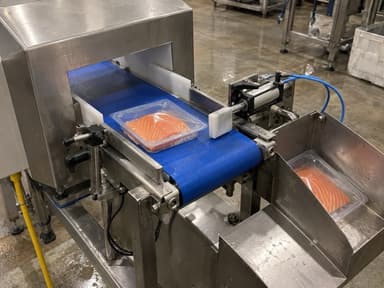
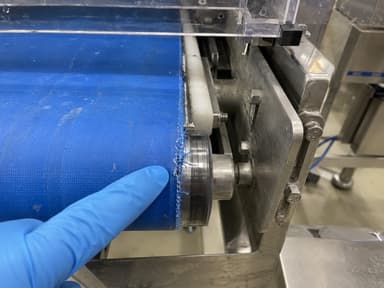
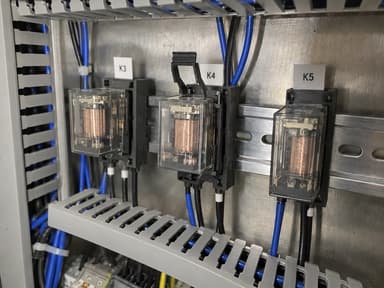 Rejecting good packs again since first thing. Third time this month, always after a format change.
T. Walker · Maintenance · 07:02
T. Walker · Maintenance · 08:26
Norlan · 08:27
On this model the belt slackens after a format change and the fault comes back within the hour if the K4 relay is not reseated. Munich hit the same thing in March; recalibrating without re-tensioning did not hold.
Manual · p. 42Munich · March
The control room
Ahead of the machines, or behind them.
The two numbers a month is judged by: how many failures it brought, and how much of the work was planned preventive maintenance rather than a reaction to unplanned downtime. Per line and per site, read from the work orders your CMMS already holds, so nobody has to build the report.
- Corrective incidents per month, and which month stood out
- Planned against unplanned work, by line and by site
- Filter by location and period; what is open is always today's
Control room
All locations · last 12 months
Incidents in the period
Corrective work orders, per month
34
corrective — 5 in the last month, the most of the year
Corrective vs preventive
How much of the work was planned
38 %
planned — 21 preventive against 34 corrective
By line
- Line 2 · Berlin31
- Line 1 · Berlin14
- Line 3 · Munich7
- Line 1 · Lyon3
Both from the work orders the CMMS already holds. Open incidents do not depend on the period: they are open today.
What repeats
The same failure, grouped across every machine it touches.
Interventions grouped by what they describe, not by which machine they came from. A row that appears on six models is a plant problem, not a machine problem, and it is the one worth a guide.
- Grouped from the text of the intervention, with nothing to tag
- How many units and how many models each family touches
- What is still open inside each family, in red
What repeats
Interventions grouped by what they describe
6 models share “Format change and adjustment”. Every row below appears on more than one model: none of them belongs to a single machine.
| Failure family | Times | Units | Models | Last |
|---|---|---|---|---|
Format change and adjustment | 15·1 | 8 | 6 | 29 Jul |
Belts and conveyors | 14 | 6 | 6 | 27 Jul |
Weight and calibration | 9·1 | 9 | 3 | 28 Jul |
Print head | 9 | 3 | 3 | 13 Jul |
Cutting and blades | 7·2 | 7 | 3 | 29 Jul |
Vacuum, sealing and film | 3·1 | 3 | 2 | 28 Jul |
Sensors and vision | 3 | 3 | 3 | 28 Jul |
In “Times”, the red figure is what is still open. The CMMS lists each of these as separate work orders.
Health by model
Which model concentrates the work, and whether it is one unit or all of them.
Every model with its units, its corrective-to-preventive ratio and what is still open. One click down: the recurring problems a technician validated, what usually fails, and how much Norlan knows about that model and since when.
- Recurring problems per model, validated by a named technician
- A memory timeline: what Norlan learned about the model and when
- When a failure repeats across units, the conversation is with the manufacturer
Checkweigher CW-500
Incidents per unit · last 12 months
Checkweigher CW-500
Installed base · Berlin and Munich
Recurring problems
The dominant problem across the units is load-cell drift: five cases on three units in six months, almost always after pressure washing or a format change. Cleaning the load-cell housing before recalibrating is what holds.
- Load-cell driftS2-PK-L4-0092 · MunichOpen
- Load-cell driftS1-PK-L1-0052 · Berlin22 Jul
Built from 2 documents and 5 threads · what 3 technicians know
What Norlan knows about this model
Knowledge risk
Which equipment depends on one person.
Who closes what, by model. The models with a single expert are marked before the sick leave, not after. Closure quality shows where root cause and fix are being written down, which is what the next technician will find.
- Models with one expert, flagged on the row
- Closures with cause and fix written, per model and per team
- A plant-level view of risk, not a league table of people
Who closes what
By model · last 12 months
8
people who close
15
models with history
3
models with one expert
| Model | Walker | Bermúdez | Costa | Weber | Ruiz | Nowak |
|---|---|---|---|---|---|---|
Labeller LB-200 1 unit · 33 closures | 6 | 7 | 6 | 7 | 7 | |
Slicer SL-7 11 units · 9 closures | 2 | 3 | 1 | 2 | 1 | |
Checkweigher CW-500 8 units · 7 closures | 2 | 2 | 1 | 1 | 1 | |
Metal detector MD-3000 1 person 7 units · 6 closures | 6 | |||||
Rotary filler RF-880 2 units · 2 closures | 1 | 1 | ||||
Vision camera VC-12 1 person 1 unit · 1 closures | 1 | |||||
Tray packer PK-40 3 units · 2 closures | 1 | 1 | ||||
Case labeller LB-40 1 person 1 unit · 1 closures | 1 |
Guides you approve
A procedure with a version, an author and a scope.
Which equipment it applies to, the spare parts it needs and their stock, who can see it, who has opened it, and what changed between versions. Drafted from the thread, approved by you.
- Scope by model and by unit, so an exception stays where it is true
- Material and spares with what is in the workshop
- Every version with who changed what, and why
Head shaft seal replacement
Guide · v3 · T. Walker, 2 days ago
Applies to
Rotary filler RF-880
2 units · Berlin Line 2, Munich Line 1
Material and spares
- Seal 32×47×8 NBR · 4 in stock1
- Copper washer M8 · 60 in stock2
Who can see it
Maintenance only · 5 people
Last opened by L. Costa, 2 h ago
Versions
v32 days ago · T. Walker
Warning about the centering pins when removing the housing
v23 weeks ago · N. Bermúdez
Torque corrected to 12 N·m ± 1
v112 Jun · T. Walker
First version, drafted from thread #1234
Where answers come from
Answers that come, more and more, from your own people.
The share of answers grounded in your team's own interventions grows as the record does; the manual is the floor. And the questions asked outside office hours are the calls that did not happen.
- Answers cited to an intervention, to the manual, or asked outside
- Questions by day and hour, with who asked and who closed
- A record that gets better with every closure, without a documentation project
Where the answers come from
453 questions · last 12 months
66 % of answers cite the plant’s own interventions — from 18 % in the first month.
- The plant’s own interventions
- The manufacturer’s documentation
- Had to ask outside
When questions are asked
39 % outside office hours — the calls that did not happen
Line workflows
The line as it runs, for the assistant and for the new hire.
Draw how each line is connected once. The assistant looks at the machines around the one that failed, and a technician who joins next month learns the line from the same map.
What maintenance managers ask
Is this a way of monitoring my technicians?
What does the CMMS keep and what does Norlan keep?
What do I see on day one, before anyone has written anything?
Do we need clean data in the CMMS first?
Can production see the panel too?
Book a demo
Bring last month's corrective list. We will show what it looks like grouped by what repeats.
We start with your operation — which failures repeat, which equipment depends on one person, what the CMMS does not hold — and then show exactly how the panel would read it.
What we usually cover
- How an incident flows today, from detection to fix
- Where the conversation actually happens: the systems, or calls and WhatsApp
- What takes longer — the diagnosis, or getting the right people and information together
- How much of what a technician knows is written down, and what happens when they are away
- Which tools are really in play: CMMS, ERP, mobile, paper
- What a pilot would measure, and how
Pick a time that suits the plant. Bring one failure that keeps coming back.
The call is with the people who build the product, with no qualification call first. Norlan is pre-general-availability and shaped with maintenance teams in pharma and food processing.